Showing posts with label Side Dish - Vegetable. Show all posts

Wednesday, August 18, 2010

Lamb Tagine with a Chickpea Okra Fry


I am officially delving into the cuisine of a new continent, one to which I have not (yet) traveled.  In honor of my coworker's upcoming trip, I have officially experimented with Moroccan and North African cuisine.  This is a big step for me--I don't think I have ever cooked a legitimate Moroccan dish.  And I guess I didn't legitimately cook a Moroccan dish this time either because I don't own a tagine.

According to the all-knowing Wikipedia, "The traditional tagine pot is formed entirely of a heavy clay, which is sometimes painted or glazed.   It consists of two parts: a base unit that is flat and circular with low sides, and a large cone or dome-shaped cover that rests inside the base during cooking.  The cover is so designed to promote the return of all condensation to the bottom. With the cover removed, the base can be taken to the table for serving."

Okay, I have to admit that it would be super-cool to own a tagine (kind of like it would be super-cool to own a huge wood-burning oven to cook pizza or, let's say, Peking duck).  But where would I fit it?  Not in my 844 square foot apartment, that's for sure.  The dilemma resulted in the use of an All Clad 4-quart sauté pan.  Hardly authentic, but it would have to do.

Moroccan lamb dishes are unbelievably tasty.  I am partial to lamb, in general, so I chose it for my North African endeavor.  I also elected to cook up two other traditional North African ingredients: okra and chickpeas.  As they say in Arabic, استمتع‎ (Istamti), which means "Enjoy!" 

Ingredients (Serves 4 People):

Lamb Tagine:
- 4 lamb shoulder chops
- Minced garlic (4 tsp. or 4 cloves)
- 1 tsp. cinnamon
- 1 tsp. ground ginger 
- 2 tsp. ground coriander
- 2 tbs. parsley (dried or fresh)
- 1 onion
- 2 1/2 cups beef stock (or lamb stock if available)
- 1 cup shredded almonds
- 2 tsp. sugar
- Olive oil
- Salt and pepper

Chickpea Okra Fry:
- 1 lb. okra
- 1 onion, roughly chopped
- 2 vine tomatoes, roughly chopped
- 1 green chili pepper, minced
- 1-inch piece of root ginger. minced
- 1 tsp. minced garlic
- 1 tsp. ground cumin
- 1 tsp. ground coriander
- 15-ounce can of chickpeas
- 1 tbs. butter
- 2 tbs. vegetable oil
- Salt and pepper

I highly recommend serving this dish with long grain white rice.  I just cooked a couple of cups in my rice cooker--super easy!  Also, you will only see two chops in my photographs because we cooked the next two the following night.  But this recipe should work perfectly for four people!

A few hours in advance (or the night before), you will need to prepare the marinade for the lamb.  In a small bowl, mix together the garlic, cinnamon, ginger, coriander, and a bit of salt and pepper. 


Finely chop up the onion.  Grab two gallon-sized baggies.  Rub the lamb shoulders with the garlic-spice mixture and then place two of the chops in each bag.


Add a tbs. of parsley and half of the chopped onion into each bag.  Seal the bags and shake them up to make sure that the ingredients evenly coat the lamb chops.  Put the bags in the fridge until you plan to start cooking.
 

Now that the lamb has marinated for at least a few hours (or overnight), you are ready to start cooking.  Heat up a few tbs. of olive oil in a large sauté pan on medium heat.  Add the lamb chops and the contents of the bags into the pan.  Fry each side of the lamb chops for 2-3 minutes.


Add the beef (or lamb) stock and lightly simmer for 30 minutes.  This will cook the lamb to a perfect medium/medium-rare (depending on the thickness of the cut).


While the lamb is cooking, start chopping.  Focus first on the onion and ginger, then on the tomato, chili, and okra.  The okra should be sliced at a slant.


First add the vegetable oil and butter to a large frying pan over medium heat.  Melt the butter and then add the garlic, ginger, and onion.  Cook for about 5 minutes until the onion starts to soften and slightly brown.  Then add the tomatoes and the chili and give it a quick stir.


Now add the okra, cumin, coriander, and some salt and pepper.  Give it a stir and cook for another 5 minutes.


After the 5 minutes are up, add the chickpeas and cook for another 5 minutes.


At this point, the 30 minutes of cooking the lamb should be up.  Remove the lamb chops and cover with foil to keep them warm.


Now let the sauce reduce a bit more (for about 5 minutes or so).


While the chickpea okra fry is finishing up and the sauce is reducing, pull out a small frying pan and brown the almonds over medium-low heat.  This is not an exact science--keep a watchful eye and remove the almonds once some of them start to brown (should be around 5 minutes).


At this point, everything should be done!  As I mentioned earlier, I cooked some long-grain rice in my rice cooker.  Yummy AND easy!


And your chickpea okra fry should look deliciously like this:

Grab a plate and serve it up!  Make sure to top with sauce and almonds.


Credits: My Lamb Tagine and Chickpea Okra Fry recipes are adapted from the cookbook, Around the World in 450 Recipes.  The photos are of our cooking process.

Thursday, July 22, 2010

Veal Saltimbocca


The recipe that I am sharing with you today is one of my favorite Italian dishes.  If you like butter, you are in for the time of your life.  The cooking style of "saltimbocca" has been around for centuries--veal saltimbocca is probably the most popular version, but you can also cook chicken and, I would imagine, other meats in this style.  I utilized my favorite online translation dictionary and discovered, to my dismay, that the English translation of saltimbocca is "slice of veal rolled with ham and sage and shallow-fried."  Seriously?  After a bit more digging, I discovered that the roots of the word quite possibly mean "jumps in the mouth."  The Italian verb "saltare" means "to jump" and the word "bocca" is Italian for "mouth."  Now THAT was what I was looking for!  This dish does exactly that--it is delectable.

The main idea is that you pan fry (in BUTTER, of course) this slices of veal that have been seasoned with sage and folded in half with prosciutto stuffed in the middle.  Once the veal is cooked, you remove it from the pan and add MORE butter and white wine to create a delightful sauce.  Some chefs will also add capers to the dish.  There is also "saltimbocca alla Romana" which means that the sauce contains Marsala instead of white wine.  But however this dish is cooked, I guarantee that it will make your bocca water...
Required Ingredients for Veal Saltimbocca (Food for Four):

- 1 lb. of veal scaloppini (thinly sliced veal--should be available in the meat department of your grocery store) 
- 1/4 lb. prosciutto, thinly sliced 
- 1 1/2 sticks (12 tbs.) of butter 
- 1 cup of white wine (I just use cooking white wine) 
- Flour (to coat veal) 
- Several tsp. of rubbed sage 
- Salt and Pepper 
- Toothpicks

I served this dish on top of spaghetti and with a side of sautéed squash and zucchini.  If you choose to cook with these items--the sauce from the veal will be a more-than-suitable topping for the spaghetti--you should also grab the following:

- 1 lb. spaghetti
- 2 small yellow squashes
- 2 zucchinis
- Minced garlic (I like to have a big container in my fridge--I use it ALL the time)
- Olive oil (Extra virgin, of course)

Go ahead and start heating up water for the spaghetti (add some salt to the water if you desire).  As the water is coming to a boil, start preparing your veal.  Put a sheet of parchment/wax paper on a cutting board.  Lay out the pieces of veal (you will probably need to do this in two batches) and cover with another piece of parchment/wax paper.  Now pull out your meat tenderizer (a mallet or even a hammer can do the job if you're desperate).  Start pounding so that the veal ends up being about 1/4 inch thick.


Now season each piece of veal with some pepper and rubbed sage (eyeball it).  Then put a piece of prosciutto on top of each piece of veal.


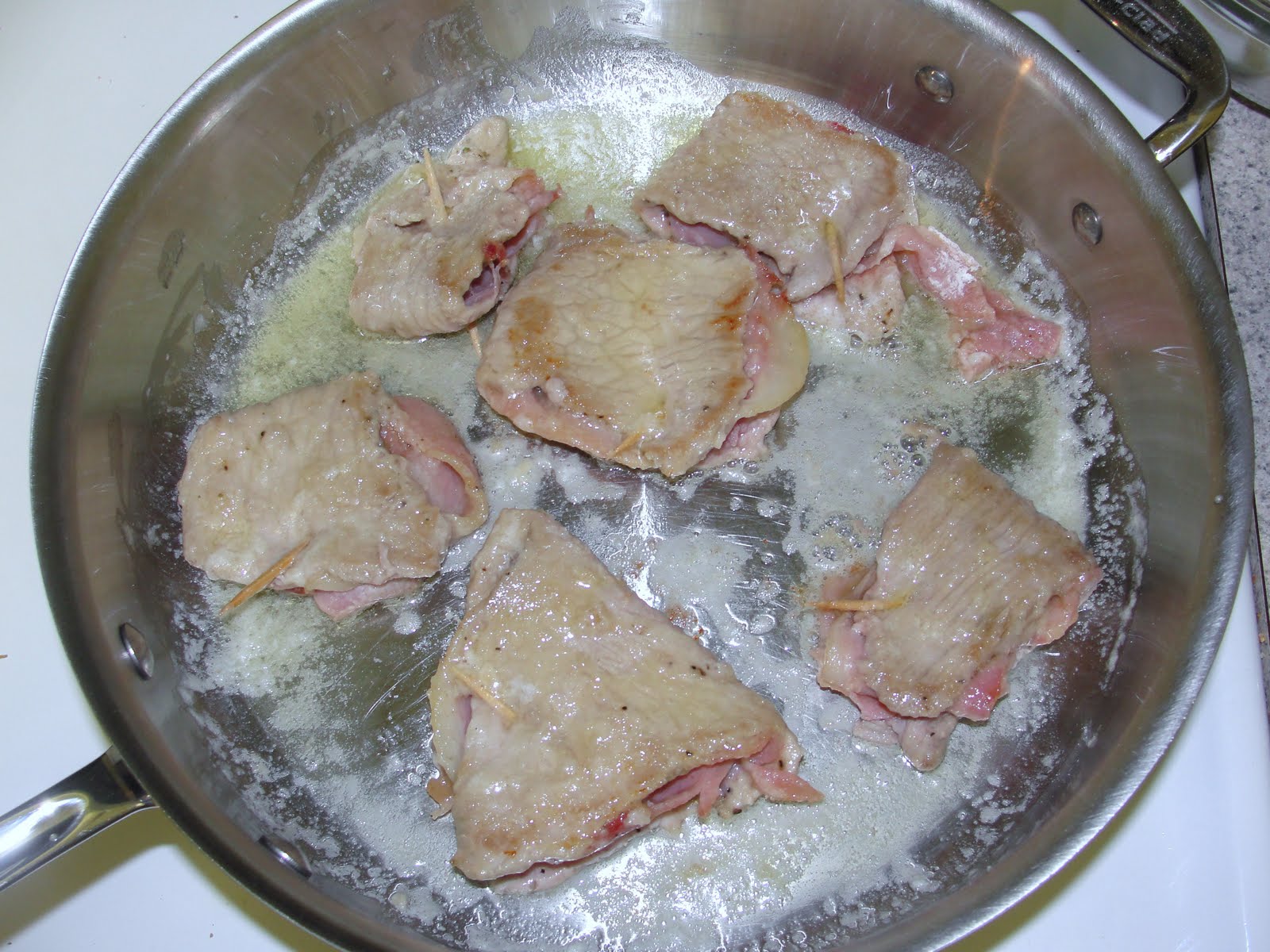
Fold each piece of veal/prosciutto in half and then secure with a toothpick.


Pull out a sauté pan and melt a 1/2 stick of butter 4 tbs.) at medium-high heat.  While melting, put some flour in a bowl.  Once the butter has melted (I was hungry...I didn't wait), coat each piece of veal/prosciutto in flour and then add to the pan.


Each side of the veal should cook for about 3 minutes (6 minutes total).


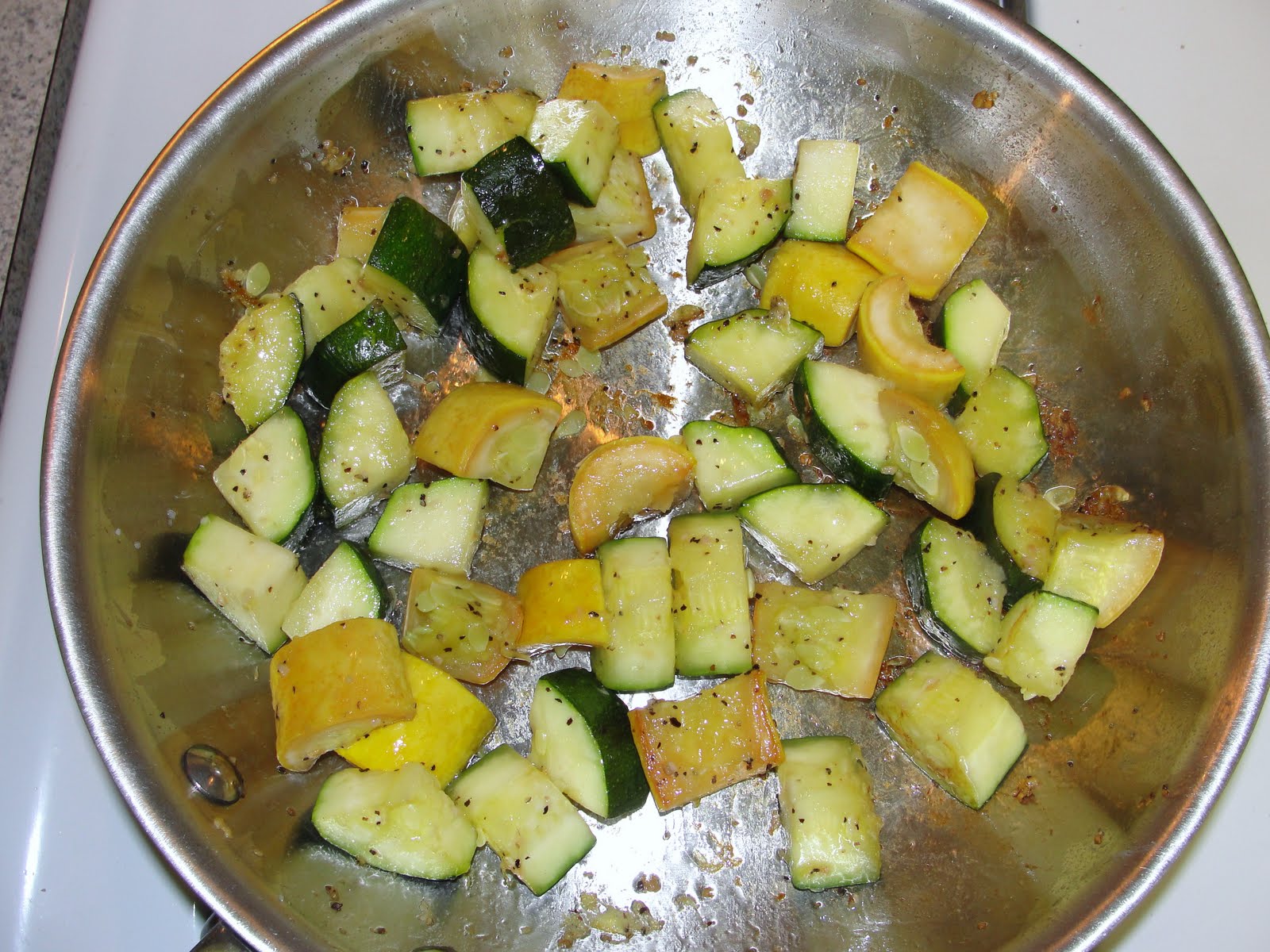
Once they have cooked, put the veal on a plate and cover with aluminum foil so that they stay warm.  If you had to do this in two batches, repeat all previous instructions (but you don't need to add any more butter to the pan).  Once you have put the last batch in the pan to cook, you should now chop up your zucchini and squash into 1-inch chunks.  Remember to flip over your veal, though!  Heat up about a teaspoon of olive oil in a frying pan over medium heat and add another teaspoon of minced garlic.  Once the garlic starts to sizzle, add the zucchini and squash chunks and top with some salt and pepper.


Don't forget to remove the veal from the heat and to add the spaghetti to the water once it has boiled.  The zucchini and squash will cook (make sure to toss them around a bit while they cook so they don't stick to the bottom of the pan) while you make the butter-wine sauce that will top your veal and spaghetti.  In the same pan that you cooked the veal, add 1 cup of white (cooking) wine.


Bring it to a boil and let it reduce for 10 minutes over medium to medium-high heat.  While it's reducing, make sure to scrape up some of the veal goodness that was left behind!  After those 10 minutes, reduce the heat on your wine to low and also reduce the heat on your zucchini and squash to low.


Make sure not to forget about your spaghetti...Now whisk 1 stick of butter in with the wine a bit at a time (don't add the whole stick at once).


Once all of it has been added, you are done!  Put a pile of spaghetti on a plate and top with a few pieces of veal and THE SAUCE.  And serve with a side of zucchini/squash and a slice of lemon.  Buon appetito!

Friday, July 9, 2010

Parrilla Style Steak with Chimichurri Sauce, Onion Rings, and Broccoli


So this is my first official blog entry. I have debated with myself on how to begin, but relatively quickly I decided to focus on perhaps the most amazing item of culinary genius: STEAK.


Now, most of you know what STEAK is (sorry veg-heads). But I’m not talking about just any steak. I’m talking about ARGENTINE beef. I’m talking about one of the sides of the fantastic cow meat triangle—maybe even the hypotenuse. The other two legs of the triangle are, of course, U.S. and Japanese beef (Texas and Kobe are among the best). I don’t include France here—they got the cut right (filet mignon is what I have tried to order at every restaurant since age 8), but long ago these three nations took over the meat supply, in my humble opinion. I also don’t include Australia/New Zealand because my only experience with these countries’ beef supply has been at Outback Steakhouse. They carry a large share of world beef exports, but sorry, guys—I’m going with quality over quantity/Bloomin’ Onion.* I am also excluding Brazilian beef from my list…this is a subject for another blog entry that focuses on churrasco (DELICIOUS).

*This statement may be amended on a future trip to Australia/New Zealand.

Now back to my focus: Argentine beef. Good meat is good meat, but there’s something about the barbeque flavor that one finds in a typically prepared Argentine steak. On a recent trip to Buenos Aires, I discovered that parrillas (steakhouses, also known as parrilladas) are practically like fast food restaurants in the United States – they are EVERYWHERE. Unlike fast food restaurants, though, they feature meat that comes from a more appealing part of the cow…and food that is edible. Parrilla also refers to the barbecue style in which the meat is cooked—and it all starts with the marinade. And it ends with Chimichurri sauce, the delicious Argentine version of A1 Steak Sauce (it’s very different, but just as common and lighter and more delicious and I really like it). Papas fritas (French fries) are a popular side dish at a parrilla, so I decided to put a twist on this and make gourmet onion rings. And even though the Argentines don’t seem to eat a lot of veggies (and by don’t seem, I mean they really don’t), I can’t really handle a meal without something green. So I made some super easy broccoli. Now on to my recipe…

Steak, Parrilla style:
- steak of your choice (we used skirt steak)
- Italian salad dressing
- garlic (minced)
- parsley
- oregano
- salt and pepper

Chimichurri Sauce (enough for 2-4 people):
- 1 cup parsley
- 1 tbs. oregano
- 1 tsp. crushed red pepper
- 5 tsp. minced garlic
- 1 tsp. salt
- ¼ cup olive oil
- 2 tbs. + 2 tsp. vinegar

Onion Rings (enough for 2 people):
- Vidalia onion
- 2 tbs. parsley
- 1 tbs. oregano
- milk
- flour
- medium bottle of vegetable oil

Super Easy Broccoli:
- broccoli (one crown is good for 2 people)
- 1 tbs. butter
- salt and pepper

Notes: If possible, prepare marinade the night before. Parsley and oregano are used throughout this recipe—buy one bunch of parsley and one of those small herb containers of oregano. That will be plenty. I also suggest having a container of minced garlic. Saves you a LOT of trouble for this meal and future recipes. An oil thermometer can be bought at the grocery.

Many different types of beef will work for this recipe—I went with skirt steak. We were cooking for two, so we picked up a package of skirt steak for about $12 or so from the grocery. Parrilla is all about the marinade…assuming, of course, that you have already prioritized the meat. I have a distaste for exact measurements when it comes to a marinade, so my recipe will be somewhat vague. Grab a large ziplock bag, throw in the steak and then add Italian salad dressing, minced garlic, parsley, oregano, salt, and pepper. The amounts you put in will depend on the size of the steak—just add so that the Italian dressing is coating the entire steak and so that you can see bits of garlic, parsley and oregano speckled across the meat. Don’t be shy with the salt and pepper. I highly recommend that you prepare the marinade the night before you plan to cook the meal. If you don’t have that much time, at least give it a few hours in the fridge. Oh, and make sure you SEAL the bag!


OK – you have waited a full day and you can’t stop thinking about how delicious tonight’s meal will be. I get it. I pulled out the Panini press (remarkably similar to a George Foreman grill) to cook the steak, but you can also use a grill pan or grill if you are lucky and have a back yard. While the grill of your choice is heating up (medium to medium-high heat on my press), start preparing the onion rings. I have a pot with a fry basket—you could also just use a pot and tongs for this. Add veggie oil into the pot. Psychologically it’s weird to use that much oil, but veggie oil is only a couple of bucks. Put the burner on medium / medium-high and insert your oil thermometer—you will be ready to fry when the thermometer hits 300° F.


Cut up the onion into…you guessed it! Rings! They should be about ½ inch thick or so.


Separate the rings and put them into a small mixing bowl. Pour in some milk on top of the onions. Grab a small plate and pour out some flour. Chop up some parsley and oregano (get all of the herb chopping done now, then separate the amount needed for the chimichurri sauce). Grab an onion ring (make sure it’s got some milk on it), dip it in the flour and coat, then transfer to another plate.


Repeat for all rings. Then sprinkle herbs on top (or you can dip the flour-coated rings in the herbs as you go).


While the oil and grill are heating, make the chimichurri sauce. Mix together the aforementioned herbs, red pepper, minced garlic, salt, olive oil, and vinegar. And that’s it.


OK back to the STEAK. Your grill should be heated up – I will let you decide how to cook your steak since I don’t know what kind of grill or cut of meat you have. I like my steak rare, so I cooked my inch-thick steak for about 3 minutes on medium / medium-high heat on the Panini press. Just remember – you can always cut through a portion of the meat to check on the doneness!


While the steak is cooking (and once the oil is heated up), add the onion rings to the pot of oil. You may have to cook them in two batches, each batch for 3 minutes. Remove rings to a paper towel coated plate.


I needed to add some greens to this dish, so I made my patented super-easy broccoli. Wash and cut up some broccoli, put it in a small corning ware dish, put a tablespoon of butter on top, add some salt and pepper, put on the cover, and microwave for 3 minutes. You can do this as the onion rings and steak are cooking—the prep time is literally about a minute. And it’s delicious.


You are done! Serve the delicious steak with chimichurri sauce and a side of gourmet onion rings and broccoli. And MAKE SURE you pull out a bottle of Malbec!

Credits: My Argentine Steak and Chimichurri Sauce recipes are adapted from a Better Homes and Gardens recipe that I found online. The onion rings recipe is loosely based on a Williams Sonoma cookbook recipe. The two “STEAK” photos are of food we ordered at Cabaña Las Lilas in Buenos Aires, Argentina. The rest of the photos are of our cooking process.